The Artist
ENRIQUECIAPARA
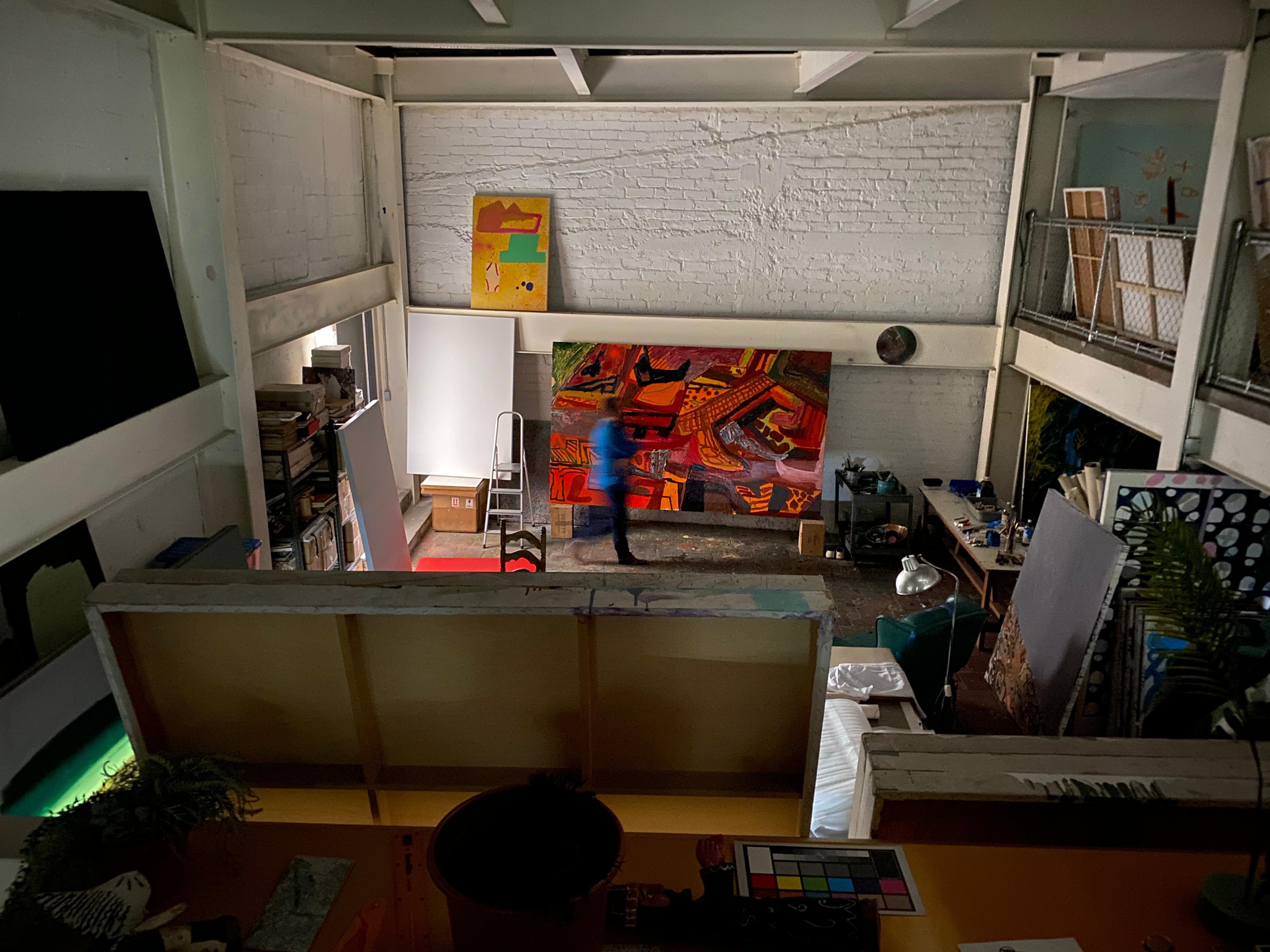
A painter from Tijuana, Enrique Ciapara moves between the abstract and semi-abstract with a practice rooted in the border landscape, the spontaneous architecture of Tijuana, and everyday kitchen objects — a body of work that redefines the relationship between place, memory, and material.
Enrique Ciapara in his studio, Tijuana, B.C.
Enrique Ciapara was born and raised in Tijuana, Baja California, a border city that would forever shape his vision. The spontaneous architecture, the violent colors of the urban landscape, and the particular light of northern Mexico became from an early age the visual vocabulary of his work. The border — as geographical condition and as mental state — is a constant presence in his work: not as an explicit theme, but as an underlying structure that informs the tension between form and matter, between order and overflow.
In his childhood, Ciapara developed an early fascination with everyday objects — the utensils of the family kitchen, the domestic surfaces worn by use, the fragments of landscape that filter through windows. This attention to the ordinary, cultivated from his earliest years, would become the thematic core of his adult practice: not the grandiloquence of the heroic gesture, but the silent dignity of what is always present and rarely seen.
Training · 1990s
His artistic training developed between Mexico and the American Southwest, where he came into contact with the tradition of printmaking and a generation of artists committed to a rigorous and autonomous practice. The technical demands of printmaking — the plate, the bite of acid, the pressure of the press — would mark his understanding of painting: as a physical act, as a negotiation with the resistance of materials.
Ciapara's early works oscillate between reduced figuration and emerging abstraction. The recurring motifs — kitchen utensils, domestic surfaces, landscape fragments — appear filtered through a sensibility that privileges process over result. In these early pieces one can already sense the principle that will govern his entire trajectory: the refusal to resolve the tension between referent and abstraction, the insistence on keeping both registers simultaneously active.
Ciapara's work presents three simultaneous aspects: texture as argument, color as memory, and gesture as architecture. The surfaces accumulate time — layers of pigment that are simultaneously a record of the process and its concealment. What distinguishes Ciapara is his refusal to resolve the tension between abstraction and referent: the kitchen, the landscape, the border remain as insinuated presences, never declared. This instability is not a limitation but the organizing principle of all his work.
Art Critic · Contemporary Art Magazine, 2018
La Brigada · 2001
In 2001, Ciapara founded La Brigada printmaking workshop in Tijuana, named after the brigade de cuisine — the hierarchy and rigor of professional cooking as a metaphor for collective, methodical artistic work. The workshop became a center of production, research, and encounter for artists of the border region. The practice of printmaking, with its technical demands and possibilities for multiplication, profoundly enriched Ciapara's pictorial work, introducing a renewed awareness of the mark, texture, and seriality.
During the workshop's early years, Ciapara developed a series of works in which the domestic kitchen occupies the center of visual inquiry. The utensils — pots, spoons, cutting boards — are subjected to a process of progressive abstraction until they lose their immediate legibility, yet retain their specific weight, their material presence. It is a poetics of the elevated everyday object: not kitsch, not conceptual, but simply honest.
Tarragona · 2010s
Throughout the 2010s, Ciapara developed extended stays in Tarragona, Catalonia, which opened his work to new chromatic and spatial registers. The Mediterranean light, Roman architecture, and a different relationship with time influenced a shift toward more luminous compositions and greater gestural freedom. What in Tijuana was tension and contrast, in Tarragona becomes openness and breath.
This dialogue between northern Mexico and southern Europe — two extremes of the Spanish-speaking world, two geographies radically distinct in their relationship with the past and with matter — remains one of the productive tensions that fuel his current practice. Ciapara does not attempt to resolve the contradiction between both worlds: he inhabits it, works it, converts it into method.
Enrique Ciapara · Recent Work · Mixed Media on Canvas
Current Practice · 2020s
Today, Ciapara alternates between Tijuana and Tarragona, keeping La Brigada workshop active and participating in group and solo exhibitions in Mexico, Spain, and the United States. His work is a continuous investigation into the limits of the image: where gesture ends and form begins, where painting remembers and where it forgets.
The most recent series delve deeper into the northern landscape — the aridity, the expanse, the light that flattens and at the same time reveals — combined with the fragmented architecture of the border city. These are paintings that do not describe a place but reconstruct it from memory: imprecise by principle, faithful for that very reason.